Mindfulness has a branding problem.
Ask most people what it means to “practice mindfulness,” and they’ll picture a serene person in white linen, legs crossed, eyes closed, sitting perfectly still somewhere in the mountains. No notifications. No crying toddler in the next room. No deadline emails piling up. Just… peace.
That image has done enormous damage to mindfulness as a practical tool. Because if mindfulness requires a perfect environment, it’s useless to most people most of the time — which is precisely when they need it.
Here’s what the best-performing wellness content online gets right: mindfulness works, and the science behind it is solid. Here’s what it mostly gets wrong: it still packages mindfulness as something you add to your day rather than something you weave into the day you’re already having. Most articles give you a list of practices, wish you luck, and leave you to figure out the rest.
This article does something different. It gives you practices that fit inside real life — and explains why each one actually works, so you’re not just following instructions blindly.
First, Let’s Settle What Mindfulness Actually Is
Mindfulness is the practice of paying attention to the present moment without judging it. That’s it. You’re not trying to clear your mind (impossible). You’re not trying to feel a certain way. You’re just noticing what’s happening right now — your breath, a sound, a sensation, a thought — and letting it be there without immediately reacting.
The reason this reduces stress is neurological. Stress triggers the brain’s fight-or-flight mode, causing the release of hormones like adrenaline and cortisol — a useful response in life-threatening situations, but damaging when the body stays in that heightened state in response to daily stressors like traffic, deadlines, or difficult conversations. Mindfulness activates the opposite response: the nervous system slows down, cortisol drops, and the thinking brain (the prefrontal cortex) regains control over the reactive brain (the amygdala).
Research published in JAMA Psychiatry found that mindfulness-based stress reduction is as effective as medication in treating anxiety disorders, including generalized anxiety disorder. That’s not a small claim. And the beauty is, you don’t need an eight-week program to start benefiting. You need five minutes and the willingness to try.
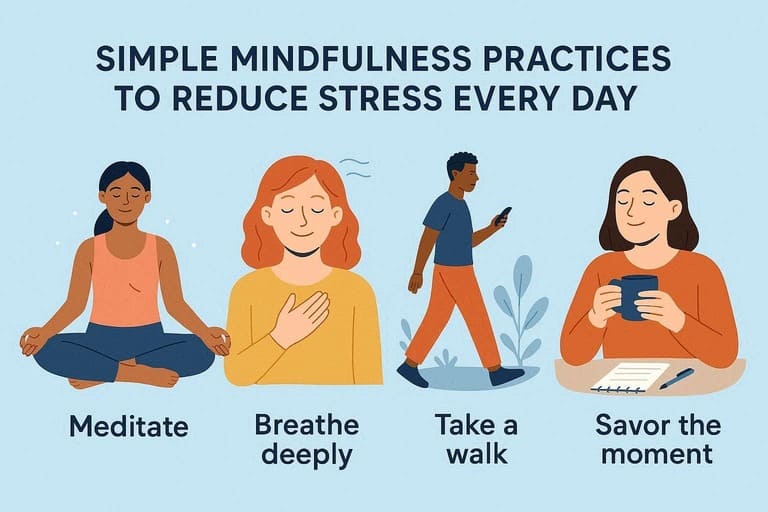
Practice 1: The Breathing Reset (2–5 Minutes)
Every article mentions breathing. Most of them don’t explain why it works better than just “calming down.”
Here’s the mechanism: your exhale activates the parasympathetic nervous system — the system responsible for rest and recovery. Your inhale activates the sympathetic system — the one that keeps you alert. So when you extend your exhale relative to your inhale, you are literally switching your nervous system into a calmer gear. This is biology, not relaxation mysticism.
How to do it:
- Inhale slowly through your nose for 4 counts
- Hold briefly for 1–2 counts
- Exhale through your mouth for 6–8 counts (longer than the inhale)
- Repeat for 5–10 cycles
One of the easiest and most effective ways to calm the nervous system is to focus on the breath — triggering deeper, fuller breathing that stimulates the parasympathetic nervous system, signalling the body to relax.
You can do this anywhere. Stuck in traffic. In a bathroom stall before a stressful meeting. In the thirty seconds before you open a difficult email. The context doesn’t matter — the physiology does.
Practice 2: The Mindful Transition (30 Seconds)
Most stress doesn’t arrive as a single dramatic event. It builds invisibly, layer by layer, as you rush from one task to the next without ever fully arriving anywhere. You’re in a meeting thinking about lunch. You’re at lunch thinking about the afternoon. You’re with your family thinking about work.
This is what psychologists call “cognitive residue” — the mental tail of one activity dragging into the next. It’s exhausting, and most people don’t notice it’s happening.
The fix is almost embarrassingly simple: pause between things.
Choose three natural transition points in your day — before eating a meal, between meetings, or when you move from one environment to another — and pause for just 30 seconds to notice your breath and surroundings. This simple practice builds mindfulness without adding extra time to your schedule.
Three breaths. Notice where you are. Notice how you feel. Then move on. That’s the whole practice. Done consistently, it stops the accumulation of unprocessed stress that makes the end of your day feel brutal.
Practice 3: The Body Scan (5–15 Minutes)
Most people live almost entirely from the neck up. They notice thoughts, emotions, and words — but not the physical tension in their jaw, the tightness across their shoulders, or the shallow breathing they’ve been doing for the last two hours.
The body scan fixes this by systematically moving your attention through different parts of your body, noticing sensation without trying to change anything. It sounds passive. The effect is not.
A simple version:
Sit or lie down comfortably. Starting at the top of your head, slowly move your attention downward — scalp, forehead, jaw, neck, shoulders, chest, arms, hands, belly, lower back, hips, legs, feet. At each area, just notice. Is there tension? Warmth? Tightness? Numbness? No need to fix anything — simply noticing begins to release it.
Research shows that even 10 minutes of mindfulness makes a measurable positive difference — and a body scan can be done in as little as that, or extended to 30 minutes for deeper relaxation.
The body scan is especially powerful before sleep. It pulls attention away from the mental chatter of the day and anchors it in physical sensation — which is far more likely to lead to rest than lying in bed replaying conversations.
Practice 4: Mindful Movement (Any Duration)
Mindfulness doesn’t require stillness. In fact, for many people — especially those who find seated meditation frustrating — moving mindfully is far more accessible.
Rhythmic, repetitive exercises such as walking, jogging, swimming, or cycling can be calming and relaxing — and once you get started, becoming aware of how your breathing complements the movement deepens the effect considerably.
The key distinction between regular exercise and mindful movement is attention. When you walk mindfully, you’re not listening to a podcast or planning dinner. You’re noticing the sensation of your feet on the ground, the rhythm of your steps, the temperature of the air, the sounds around you. You’re fully in the experience rather than using it as background to more thinking.
Even five minutes of mindful walking — genuinely paying attention — can break a stress spiral more effectively than twenty minutes of distracted jogging.
Practice 5: The Sensory Anchor (Instant, Anytime)
This one competes with nothing in your schedule because it takes zero extra time. It’s the practice of briefly anchoring to one of your five senses in the middle of whatever you’re already doing.
- While making coffee: really smell it, feel the warmth of the cup
- While washing your hands: feel the temperature of the water, the texture of the soap
- While eating lunch: actually taste the first three bites before going on autopilot
- While walking to a meeting: notice five things you can see that you haven’t consciously noticed before
Everyday activities like washing dishes can become mindfulness exercises simply by tuning into sensations rather than distractions — a simple shift that lowers cortisol levels and promotes clearer thinking.
This practice is useful precisely because it requires nothing. No time set aside. No app. No quiet room. It works because the brain cannot simultaneously ruminate about the past or worry about the future while it’s fully engaged with a present sensory experience. You are literally interrupting the stress loop by redirecting attention.
The Mistake Everyone Makes: Chasing the Perfect Session
Here’s the part most wellness content skips: mindfulness works through consistency, not intensity. A five-minute practice every day for a month outperforms a forty-minute session once a week by a significant margin.
Building a stress relief habit doesn’t have to feel like another task on your to-do list. Start small by tying one calming activity — like breathing or a brief body check — to something you already do each day. The goal isn’t perfection. It’s progress through consistency.
Pick one practice from this list. Just one. Attach it to something you already do — your morning coffee, your commute, the moment before dinner. Do it for two weeks without judging whether it’s “working.” Then add a second practice.
That’s the entire method. Unglamorous, reliable, and backed by decades of research.
The Bigger Picture
Mindfulness isn’t about escaping your life. It isn’t about achieving a permanent state of calm or transcending the chaos of modern existence. It’s about developing a slightly longer pause between the thing that stresses you and your reaction to it.
Instead of immediately reacting to stressors, mindfulness develops a crucial pause between stimulus and response — a space that allows you to choose how you respond rather than being controlled by automatic reactions.
That pause is everything. It’s the difference between sending the email you’ll regret and the one you won’t. Between snapping at someone you love and taking a breath first. Between feeling swept away by your day and feeling — just slightly, just enough — like you’re steering it.
Start with one breath. The rest follows.