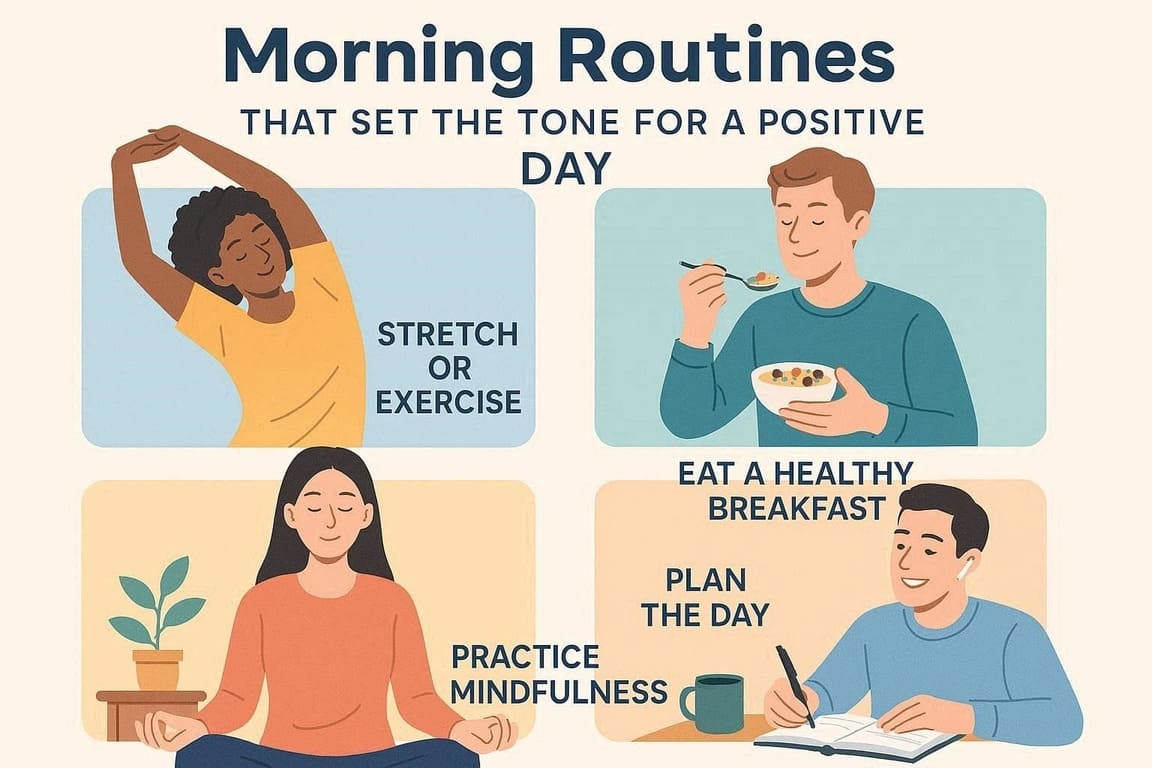
The internet has a morning routine obsession — and an increasingly unhelpful one.
Scroll through the top-ranking articles on this topic and you’ll notice something: they all look the same. Wake up early. Meditate. Journal. Exercise. Eat a healthy breakfast. Cold shower optional. The list is polished, the advice is generic, and somewhere in paragraph three there’s usually a reference to what Elon Musk or Oprah does before 7 AM.
This kind of content isn’t useless. But it has two serious problems. First, it treats morning routines as performance — something you do to optimise output, signal discipline, or keep up with high achievers. Second, it hands you a twelve-step programme without explaining the why behind any of it, which means when life gets busy and the routine collapses, you have no idea what to keep and what to drop.
This article does something different. It explains what’s actually happening in your brain and body during the first hour of the day, identifies the small number of habits that produce the most meaningful impact, and gives you a framework flexible enough to survive a real week — not just a perfect one.
What’s Actually Happening in Your Brain in the Morning
Before you can design a useful routine, it helps to understand what you’re working with.
When you wake up, your body is still in a state of physiological transition. Your core temperature is rising, cortisol is peaking (this is the natural “get up and go” hormone, not the stress villain it’s often made out to be), and your brain is gradually shifting from the slower theta waves of sleep to the faster alpha and beta waves of waking alertness.
Current evidence supports earlier sleep timing and consistent wake-up times as behavioural anchors for cognitive performance, emotional regulation, and long-term health — and greater day-to-day variability in sleep schedules is associated with poorer mental and cardiometabolic outcomes.
In plain terms: your brain and body are highly responsive to what happens in the first thirty to sixty minutes of the day. The inputs you give them during this window — light, movement, hydration, calm or chaos — set the neurological tone for everything that follows. This is not metaphor. It’s biology.
A survey of over 1,000 Americans found that 90% say their morning routine sets the tone for their mental wellness for the remainder of the day. The science backs up what most people already sense intuitively — but knowing why it works helps you make smarter decisions about what to include.
What Most Morning Routine Articles Get Wrong
Beyond the obsession with high achievers’ schedules, competitor content tends to make three key mistakes:
They confuse length with effectiveness. A 90-minute routine packed with habits isn’t better than a 20-minute one. Research consistently shows that consistency matters far more than duration — and overly ambitious routines are abandoned faster.
They ignore your actual sleep quality. Most articles skip straight to “wake up earlier” without addressing the fact that a morning routine built on poor sleep is structurally unsound. The foundation matters. A routine that doesn’t account for sleep is like decorating a house with a broken foundation.
They list habits without hierarchy. Not all morning practices are equal. Some are foundational (they enable everything else). Some are supplemental (nice to have, but optional). Treating them as interchangeable leads to choice paralysis and half-built routines.
Here’s a cleaner framework.
The Foundation Layer: Three Non-Negotiables
These are the habits with the strongest evidence base and the highest return on investment. If your morning is short, start here and only here.
1. Consistent Wake Time
This is the single most powerful morning habit — and the most unglamorous.
Maintaining a consistent wake time strengthens circadian entrainment and stabilises sleep-wake cycles. Waking late or experiencing prolonged sleep inertia can negatively affect the success of morning target behaviours.
It doesn’t matter if you wake at 5 AM or 7:30 AM. What matters is that you wake at the same time every day, including weekends. This one habit stabilises your circadian rhythm, improves sleep quality, and makes waking easier over time. It’s the clock everything else runs on.
2. Morning Light Within 30 Minutes of Waking
Get natural light — ideally sunlight — into your eyes within the first thirty minutes of being awake. Step outside. Open the blinds. Sit near a window. This isn’t wellness aesthetics; it’s neuroscience.
Key morning behaviours — including light exposure, consistent wake-up times, physical activity, and mindfulness — work synergistically to improve daily mental and emotional functioning, and circadian-aligned morning routines support cognitive performance and mood regulation by stabilising circadian rhythms and neuroendocrine signalling.
Light exposure suppresses residual melatonin, signals the brain that the day has begun, and anchors your internal clock. Fifteen minutes of natural light in the morning also significantly improves sleep quality at night — which feeds back into every morning that follows.
3. Hydration Before Caffeine
Your body loses water through breathing and sweat during sleep. After seven or eight hours without intake, mild dehydration is common — and it impairs mood, concentration, and energy in ways that are easy to misread as “just being a morning person.”
Beginning your day with a glass of water can increase alertness and energy levels, setting a positive tone for continued hydration throughout the day — and dehydration can trigger symptoms like weakness, dizziness, and low blood pressure while negatively affecting mood and concentration.
Drink a full glass of water before your coffee. It takes ten seconds and the effect is real.
The Middle Layer: High-Impact Add-Ons
Once the foundation is consistent, these practices meaningfully elevate your morning without requiring significant time.
Movement (Even 10 Minutes)
Research shows that circadian-aligned morning routines, including physical activity, support cognitive performance and mood regulation by stabilising sleep-wake cycles and enhancing mental clarity throughout the day.
This doesn’t mean a full workout. A ten-minute walk outside combines movement, light exposure, and a transition out of the home environment in a single habit. For many people, this is the highest-efficiency morning investment available. The key is moving your body enough to raise your heart rate slightly and shift your physical state from horizontal stillness to upright engagement with the world.
Intention-Setting (5 Minutes)
Setting a positive intention for each day — identifying a goal, consciously choosing to approach life with a positive outlook, or setting a simple plan — helps build motivation and clarity, and psychologists recommend intention-setting as a way to reinforce the purpose behind daily actions.
This can be journalling, a short meditation, or simply sitting quietly for five minutes and deciding what matters most today. The format is less important than the act of pausing between waking and reacting — creating a moment of choice before the day’s demands start arriving.
A clear and intentional morning routine helps eliminate decision fatigue — the mental drain caused by making too many small decisions — and by establishing a consistent schedule, you free up mental space for focus and creativity.
A Real Breakfast
A balanced breakfast provides essential fuel for maintaining steady energy and positive mood throughout the day — while skipping breakfast can impair concentration and emotional regulation, and research indicates that nutrient-dense morning meals may reduce stress and depressive symptoms.
This doesn’t require a complicated meal. Protein, complex carbohydrates, and healthy fat — eggs, yogurt with fruit, oats, or a simple smoothie — stabilise blood sugar and prevent the mid-morning energy crash that derails focus. The specifics are less important than eating something real rather than skipping breakfast entirely.
The One Habit Most Lists Leave Out: Delaying Your Phone
Not checking your phone first thing in the morning is a great hack for decreasing stress levels and improving focus throughout the day.
This is consistently underemphasised in morning routine content, possibly because it’s not photogenic. But neurologically, reaching for your phone the moment you wake throws you immediately into reactive mode — responding to other people’s priorities, consuming news or social comparison, and triggering low-level stress before your nervous system has had a chance to stabilise.
Even a 20-to-30-minute delay between waking and opening your phone produces a measurable improvement in mood and cognitive clarity. It’s not about technology being bad. It’s about giving your brain a few minutes to belong to itself before it belongs to everyone else.
Building a Routine That Survives Real Life
Research has shown that individuals with lower levels of daily routine report higher levels of anxiety and depressive symptoms compared to those with more structured routines — and daily routines contribute to a sense of coherence and predictability, which can enhance psychological well-being by promoting a sense of control and self-efficacy.
But routines only produce these benefits when they’re actually maintained. A perfect routine that collapses on Wednesday is less valuable than an imperfect one that holds up through Friday.
A few principles that help:
- Start with two habits, not twelve. Consistent wake time and morning light. Nail those for two weeks before adding anything.
- Attach new habits to existing ones. Water before coffee. Walk after waking. Intention-setting while the kettle boils. Friction is lower when new habits ride alongside established ones.
- Design for your worst morning, not your best. What’s the minimum version of this routine that still captures most of the benefit? Know that number, and use it on hard days instead of abandoning the routine entirely.
- Treat the routine as personal, not aspirational. The goal is not to replicate someone else’s morning. It’s to start your day in a way that makes you feel grounded.
The Bottom Line
A morning routine isn’t about productivity hacking or performing wellness. It’s about giving your brain and body a stable, intentional start — one that reduces the friction of the day before it begins.
Routines offer stability, reduce stress, and provide a framework for positive habits that reinforce emotional resilience. And the approach to building them should be one of patience and self-compassion, allowing them to grow with you over time — not perfection, but small steps that support feeling your best.
Wake at a consistent time. Get some light. Drink water. Move a little. Put the phone down for twenty minutes. That’s the core. Everything else is optional.