
Your home is either working for your mental health or against it. There’s very little neutral ground.
Home is the one place most people expect to feel safe, calm, and restored. And yet, for a growing number of people, walking through the front door doesn’t trigger relief — it triggers a low-level, hard-to-name anxiety. The pile of unopened mail on the counter. The chaotic kitchen. The bedroom that never quite feels like a retreat. The rooms that look lived-in but don’t feel peaceful.
This gap between what home is supposed to feel like and what it actually feels like is the subject of a surprising amount of rigorous research — and a surprisingly shallow amount of quality content online.
Search “how to build a peaceful home” and you’ll mostly find two types of articles. The first is the aesthetics piece: soft neutrals, linen cushions, a ceramic vase of dried pampas grass. Beautiful, aspirational, and largely inaccessible to anyone without a design budget and an empty home to start from. The second is the decluttering listicle: throw things away, buy fewer things, follow the KonMari method. Useful in a narrow sense, but it treats the problem as purely physical — a matter of square footage and storage solutions — when the reality is more layered than that.
What neither type of article does well is explain the why: the actual mechanisms by which your environment affects your nervous system, your mood, your cortisol levels, and your quality of sleep. And without understanding the why, you’re making changes blindly, with no sense of which ones will actually move the needle.
This article fixes that.
What Your Home Is Actually Doing to Your Brain
Americans spend about 87% of their time inside buildings — and the majority of that time is at home. That’s not a backdrop statistic. It means your home environment is one of the most consistent and powerful inputs into your mental state, day after day, year after year. Small problems in that environment compound in ways that are easy to underestimate.
Here’s what the research has established clearly:
Clutter raises cortisol. A 2010 UCLA study showed that when people viewed their homes as cluttered, their cortisol rates rose throughout the day — while those who didn’t experience a clutter problem noticed their cortisol levels drop as the day progressed. Cortisol is your primary stress hormone. Chronically elevated cortisol is linked to anxiety, disrupted sleep, weight gain, and impaired immune function. Your messy living room isn’t just aesthetically unpleasant — it’s a physiological stressor running in the background every hour you’re home.
Disorder impairs focus and sleep. A disorganized environment and a cluttered mind can overwhelm your brain, impair your focus, increase anxiety and stress, disturb your sleep, and dampen mood and memory. Studies from both Princeton and St. Lawrence University showed that people in cluttered homes are significantly more likely to suffer from insomnia — because the brain registers unresolved visual chaos and stays in a low-level alert state, even at night.
The framing of your home matters. People with higher “restorative home” scores — homes described using words relating to calm and nature — had healthier cortisol patterns across the day, while those with higher “stressful home” scores showed flatter diurnal cortisol slopes, a profile associated with adverse health outcomes. In other words, the way your home makes you feel has measurable physiological consequences.
The good news is that these effects work in both directions. Improve the environment, and the biology responds. A 2022 study in the Journal of Environmental Psychology found that individuals who made small but intentional changes to their living environment reported a 21% reduction in stress levels over six months.
What to Actually Change (and Why)
1. Declutter the Entry and Living Spaces First
Researchers have found that people have lower stress levels if they enter their homes in a clutter-free space. The entry point matters disproportionately. The moment you walk in the door sets the neurological tone for your time at home. A cluttered hallway tells your brain: there is unfinished work here. A clear, organised entry says: you can relax now.
You don’t need to tackle the whole house at once — in fact, trying to do so is one of the main reasons decluttering efforts fail. Instead:
- Start with a single high-traffic surface: the kitchen counter, the entry table, or the coffee table. Clear it completely and keep it clear for two weeks.
- Apply the one-minute rule: if something can be put away in under a minute, do it immediately instead of setting it down “for now.”
- Use the 90-day test for objects you’re unsure about: if you haven’t used it in 90 days and won’t in the next 90, it’s visual noise — not a possession.
The goal isn’t a minimalist showroom. It’s a home where your brain doesn’t have to process a backlog every time your eyes scan a room.
2. Fix Your Lighting — Natural First, Artificial Second
Natural light is one of the most powerful mood enhancers. A well-lit room, especially with access to sunlight, can increase serotonin levels and improve mood. Similarly, proper ventilation ensures a flow of fresh air, which has been linked to better concentration and reduced fatigue.
Most people accept the lighting in their home as fixed. It isn’t. Lighting is one of the highest-leverage, lowest-cost changes available:
- Maximise natural light during the day: pull back curtains fully, clean windows, move large furniture away from windows if it’s blocking light flow.
- Switch to warm-toned bulbs in living spaces and bedrooms: cooler white light in the evening signals “daytime” to your brain and suppresses melatonin production, degrading sleep quality.
- Use lamps instead of overhead lighting in the evening: lower, warmer light pools create a sense of enclosure and calm that flat overhead lighting does not.
- Consider a daylight lamp for darker months: seasonal light deficiency affects mood, energy, and focus — a quality daylight lamp used in the morning can substantially offset this.
Smart lights that copy natural light are popular in 2025, with nearly 39% of UK homeowners now using smart tech to make their homes better for wellbeing. You don’t need expensive smart home systems to get the benefits — the principle is simple: warmer and dimmer as the evening progresses.
3. Bring Nature Indoors — Biophilic Design Without the Jargon
Biophilic design — incorporating natural elements into built environments — has been shown in hospital settings to reduce patient stress, alleviate anxiety, and support faster recovery. The effect scales down to the home just as readily.
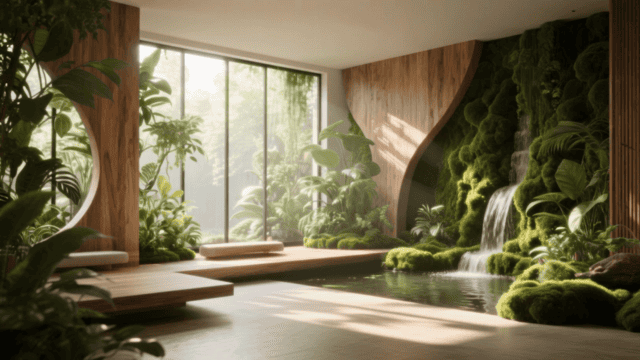
More than 84% of UK people report feeling better with plants and greenery in their homes. This aligns with a wider body of research showing that even visual access to natural elements — plants, wood textures, water features, natural light — reduces physiological stress markers.
Practical biophilic changes that don’t require renovation:
- Add plants to high-traffic rooms: snake plants, pothos, and peace lilies are low-maintenance and effective at improving both air quality and mood.
- Use natural materials where possible: wood, cotton, linen, and stone have calming associations that synthetic surfaces do not. Swapping a plastic storage box for a woven basket costs little and changes the sensory quality of a room.
- Introduce water sound: a small tabletop water feature in a living room or bedroom costs very little and produces an ambient sound that reliably lowers heart rate.
- Use nature-adjacent colours: calming colour palettes, such as neutral tones or green and blue hues, can create a sense of peace and calm within a room, ultimately promoting the space’s emotional well-being.
4. Design Your Bedroom as a Sleep Environment — Not a Multipurpose Room
If your bed or bedroom is filled with boxes, junk, or work items, your brain might not fully associate the space with rest — and studies have found that people living in cluttered homes are more likely to experience insomnia and poor sleep quality.
The bedroom is the room with the highest stakes — the quality of sleep it enables affects everything else. A few non-negotiable adjustments:
- Remove work items from the bedroom completely. Laptops, notebooks, and anything that represents professional obligation erode the sleep-association with the space. Even a work bag visible in the corner can maintain low-level arousal.
- Keep the room cool: research supports 16–19°C (60–67°F) as the optimal sleep temperature range.
- Use blackout curtains or an eye mask: even low ambient light during sleep disrupts melatonin and degrades sleep architecture.
- Keep surfaces clear: a cluttered bedside table is the last thing your eyes rest on before sleep and the first thing they process on waking. Both matter.
5. Create at Least One “Restorative Zone”
Not every room needs to be a sanctuary. But every home should have at least one space that is intentionally designed for decompression — a corner, a chair, a window seat — somewhere that sends a clear signal: this space is for nothing urgent.
Control — or even perceived control — is crucial. Having the space to decorate, personalise, organise, and regulate ourselves can help us reach that important level of comfort and ease in our own lives.
Your restorative zone doesn’t require redecorating. It requires:
- A comfortable seat you actually like sitting in
- Good natural or warm light
- No screens within easy reach
- Something sensory that you associate with calm: a specific candle scent, a soft blanket, a plant, a book within arm’s reach
The ritual matters as much as the space. Using the same spot consistently to read, breathe, or sit quietly trains your nervous system to associate that location with restoration — the same mechanism that makes a regular sleep space more effective over time.
6. Manage Noise as Seriously as Visual Clutter
Sound is an underappreciated element of home environment. Excessive noise can increase stress levels and contribute to poor mental health. White noise machines or calming background music can also help mask disruptive sounds and promote better sleep.
For those in urban environments or shared buildings:
- Soft furnishings absorb sound: rugs, curtains, upholstered furniture, and bookshelves all reduce echo and ambient noise in meaningful ways.
- Create intentional sound environments: in the evening, replace TV-as-background with ambient music, nature sounds, or silence. The default habit of leaving the television on adds a constant layer of stimulation that prevents the nervous system from winding down.
- Establish quiet hours: especially if working from home, designating certain hours as low-sound creates temporal as well as physical space for recovery.
The Compound Effect of Small Environmental Changes
Individuals in decluttered environments report a 23% improvement in overall well-being and a 33% decrease in daily stress levels. These aren’t dramatic renovations producing those numbers. They’re the accumulated effect of smaller, consistent changes.
The principle underlying all of this is simple: mental health and home design are intricately linked — a thoughtfully designed home fosters emotional balance, helping to regulate stress and improve daily functioning.
You don’t need an interior designer. You don’t need a bigger home. You don’t need to buy anything expensive. You need to look at your home through the lens of how it makes you feel — and make intentional changes to close the gap between what it is and what you need it to be.
Start with one surface. Clear it. Keep it clear. Notice what changes.
Then build from there.
