The problem isn’t that you can’t sleep. It’s that you haven’t designed the hours before sleep.
Most people treat sleep like a switch. They work, scroll, stress, and stay stimulated right up until the moment they close their eyes — then wonder why sleep doesn’t come quickly, or why they wake feeling unrested despite being in bed for eight hours.
The wellness internet has noticed this problem. Search “evening habits for better sleep” and you’ll find plenty of responses: dim the lights, take a bath, put your phone away, drink chamomile tea. The advice is fine. The problem is that most articles deliver it as a flat, interchangeable list with no sense of why each habit works or how much it actually matters. You’re left trying to cram twelve new behaviours into your evening and wondering which ones to keep when real life gets in the way.
This article takes a different approach. It explains what’s actually happening in your brain and body during the evening hours, identifies the habits with the highest sleep return, and gives you a framework you can actually sustain — not just a list to feel guilty about.
What Your Body Is Trying to Do in the Evening (And What Gets in the Way)
To build a genuinely effective evening routine, it helps to understand the biology you’re working with.
Starting in the late afternoon, your body initiates a cascade of changes designed to prepare you for sleep. Core body temperature begins to drop. The hormone melatonin — your body’s primary sleep signal — starts rising as light fades. Cortisol, which peaks in the morning to get you moving, steadily declines.
This process is elegant, automatic, and surprisingly fragile. Three things reliably disrupt it:
- Artificial light — especially the blue-spectrum light emitted by phones, laptops, and televisions — suppresses melatonin production by tricking the brain into thinking it’s still daytime. Electronic devices, including computers, televisions, smartphones, and tablets, all emit strong blue light, which floods the brain while using these devices, tricking it into thinking it is daytime — as a result, the brain suppresses melatonin production and works to stay awake.
- Mental stimulation — emails, news, difficult conversations, and anything that activates the problem-solving brain keeps your nervous system in alert mode, which is the neurological opposite of sleep readiness.
- Irregular timing — consistent, moderate-certainty evidence links greater sleep-timing irregularity to higher depressive and anxiety symptoms, elevated body mass index, insulin resistance, hypertension, and incident cardiovascular events. Your body’s internal clock runs on consistency. When the timing shifts night to night — staying up late on weekends, sleeping in on Mondays — the clock gets confused, and sleep quality suffers.
Understanding these three disruptors tells you most of what you need to know about building an effective evening routine.
What Most Evening Routine Articles Get Wrong
Before the habits, a quick look at where competitor content falls short.
They treat all habits as equal. A typical article lists “journalling” alongside “avoid caffeine after 2 PM” as though these have similar weight. They don’t. Some habits address the core biology of sleep. Others are supplemental. Knowing the difference matters when your evening is short.
They ignore the “sleep anxiety” problem. Wellness brands and sleep experts are increasingly advocating for mindful sleep practices that prioritize relaxation over rigid sleep goals — as sleep anxiety continues to rise, particularly among younger generations. Many articles inadvertently create more anxiety by presenting sleep as something you can optimise or fail at. A good evening routine should lower the stakes, not raise them.
They don’t address the transition problem. The real challenge isn’t finding thirty minutes for a wind-down ritual. It’s transitioning from the high-stimulation mode of the day into a state where rest is actually possible. The best evening habits are really transition mechanisms — and the articles that don’t frame them this way make them harder to apply.
The Habits That Actually Matter
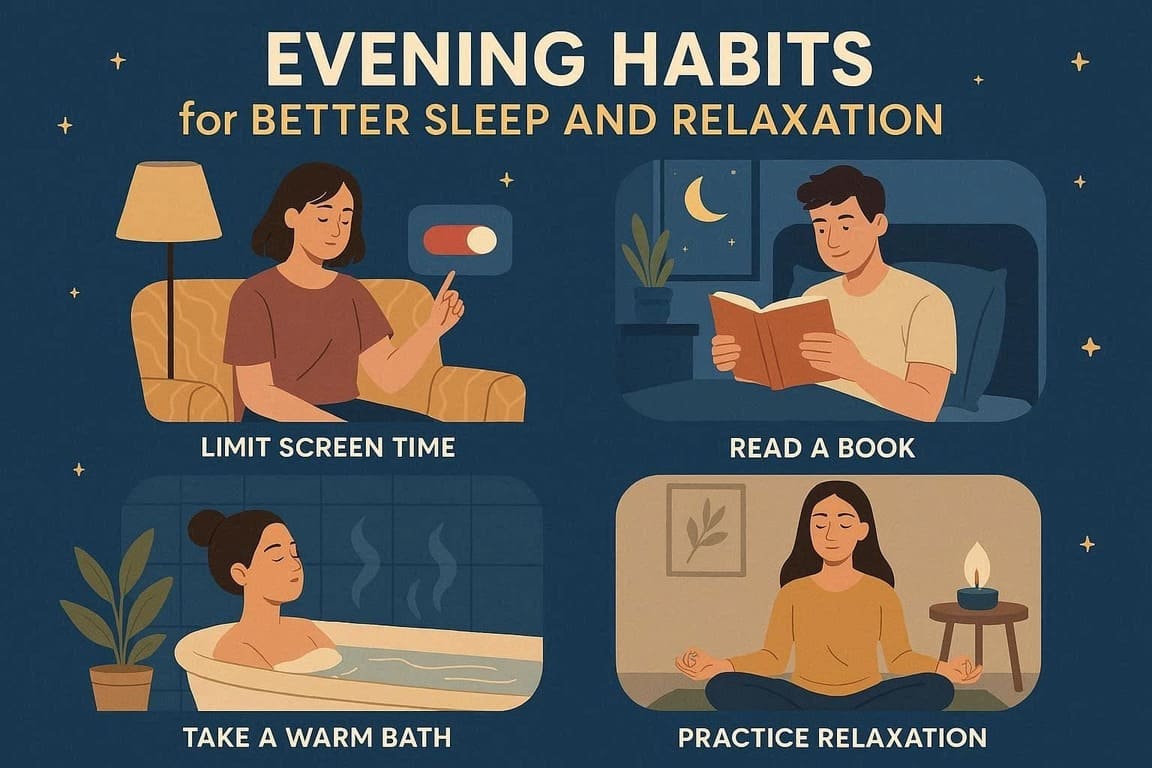
1. Set a Screen Curfew — and Make It Earlier Than You Think
This is consistently the highest-impact change most people can make. The research is unambiguous and increasingly specific. Compared with people who avoided screens before bed, those who used them had a 33% higher rate of poor sleep quality — and slept about 50 minutes less each week. Fifty minutes of lost sleep per week adds up fast: that’s over four hours a month, every month.
Powering down electronics at least 30 to 60 minutes before bed is the standard recommendation — but 90 minutes is better if you can manage it. The goal isn’t to eliminate evening technology use entirely; it’s to create a buffer between screen stimulation and sleep onset.
Practical ways to make this stick:
- Put your phone on Do Not Disturb and leave it charging outside the bedroom
- Replace the scrolling habit with something physical — a book, stretching, a conversation
- Use your TV’s sleep timer instead of watching until you can’t keep your eyes open
- Enable blue-light filtering on devices you do use in the evening
2. Warm Bath or Shower — The Body Temperature Trick

This one surprises people. Scientists have found that a warm bath can trigger a sleepy reaction — your body heats up from the water, and cools down quickly as the water evaporates, creating a sensation that makes you feel tired and relaxed. Consider taking a warm bath at least an hour before going to sleep.
The mechanism is the same one your body uses naturally: falling core temperature is a primary trigger for sleep onset. A warm bath accelerates this process by briefly raising your surface temperature and then allowing it to drop. It’s a reliable, drug-free sleep signal you can give your body any night.
Ten to fifteen minutes is enough. The timing matters — an hour before bed is the sweet spot. This is one of the most underutilised evening habits, possibly because it feels too simple.
3. Write Tomorrow’s To-Do List
Racing thoughts at bedtime — replaying the day, planning tomorrow, cataloguing unfinished things — is one of the most common obstacles to falling asleep. The brain’s default mode network activates when you lie down with nothing to do, and if you haven’t given it a place to put your worries, it will keep running them.
Many people find journalling restorative in the evening, as it helps sort out thoughts and feelings before bed — and one study found that taking five minutes before bed to jot down a quick to-do list of tasks that needed to be done in the following days significantly helped with sleep.
The logic is counterintuitive: you sleep better by engaging briefly with tomorrow, not by pretending tomorrow doesn’t exist. A written list acts as a cognitive “offload” — you’re signalling to your brain that the information is stored and no longer needs to be actively held in working memory. Five minutes of writing can buy you thirty minutes of faster sleep onset.
4. Design a Wind-Down Anchor Activity
The most effective evening routines have one consistent anchor activity — something that your brain eventually learns to associate with sleep. Doing calming activities before bedtime, such as taking a bath or using relaxation techniques, promotes better sleep.
What that activity is matters less than the fact that it’s consistent. Options with strong evidence behind them:
- Reading physical books — not e-readers, which emit blue light, but paper books. Even fifteen minutes of reading reduces physiological stress markers measurably.
- Gentle stretching or yoga — releases physical tension accumulated through the day and activates the parasympathetic nervous system.
- Listening to calm music — music can be a powerful relaxation tool; the genre is not important, so long as the music calms you.
- Progressive muscle relaxation — systematically tensing and releasing muscle groups from feet to head, which reduces physical tension and lowers cortisol.
The anchor doesn’t need to be long. Fifteen to twenty minutes, done consistently, trains your nervous system to begin its sleep descent at a predictable time.
5. Make Your Bedroom a Sleep Environment — Not a Living Space
Keep your room cool, dark and quiet — exposure to light in the evenings might make it more challenging to fall asleep, and avoiding prolonged use of light-emitting screens just before bedtime is key.

The environmental checklist is short but significant:
- Temperature: Between 16–19°C (60–67°F) is the research-supported range for optimal sleep. Most people sleep in rooms that are too warm.
- Darkness: Blackout curtains or an eye mask. Even low ambient light disrupts sleep architecture.
- Quiet: Earplugs, a white noise machine, or a fan if your environment is noisy.
- Association: Avoid working, eating, or watching content in bed. The bed should be mentally associated with sleep and rest only — when this association is strong, lying down becomes its own sleep signal.
6. Watch Your Caffeine Timing — More Than You Think
This one appears on every list, but most articles underestimate the window. Caffeine has a half-life of approximately five to six hours — meaning half the caffeine from a 3 PM coffee is still active in your system at 9 PM. For sensitive individuals, that window extends further.
The practical rule: no caffeine after 1–2 PM if you plan to sleep by 10–11 PM. Many people who believe they have a sleep problem actually have an afternoon caffeine habit.
The One Thing to Stop Trying to Do
Here’s what almost no sleep article says directly: stop trying to make yourself fall asleep.
Sleep onset cannot be forced. The harder you try, the more alert you become. When evaluating sleep habits, the challenge becomes figuring out how to break bad habits and having a plan in place if you falter — and that plan must include forgiving yourself if you have slip-ups, and making sure you only start with one or two routine changes at a time.
The evening routine’s entire purpose is to remove the barriers between you and sleep — not to perform sleep wellness. When the environment is right, the nervous system is calm, and the mind has been given somewhere to put its unfinished business, sleep generally follows on its own.
Set the conditions. Step back. Let the biology do the rest.
A Practical Evening Framework
For those who want a simple structure to start with:
- 2 hours before bed: Screen curfew begins; switch to warm, dim lighting
- 90 minutes before bed: Warm bath or shower if using this habit
- 60 minutes before bed: Anchor activity — reading, stretching, calm music
- 30 minutes before bed: Write tomorrow’s to-do list; five minutes of breathing or relaxation
- Bedtime: Same time every night, including weekends
You don’t need all of these on every evening. But the more consistently you run this sequence, the more powerfully your body will learn to associate the routine with sleep — and the less effort each night will require.
The Bottom Line
Good sleep isn’t something you achieve in the hour before bed. It’s something you build across the entire evening by gradually withdrawing from stimulation and giving your nervous system permission to slow down.
The habits above aren’t complicated. What makes them powerful is consistency. Start with one — the screen curfew, if you’re choosing — and hold it for two weeks before adding anything else. Build slowly. The compounding effect is real, and your mornings will tell you when it’s working.