
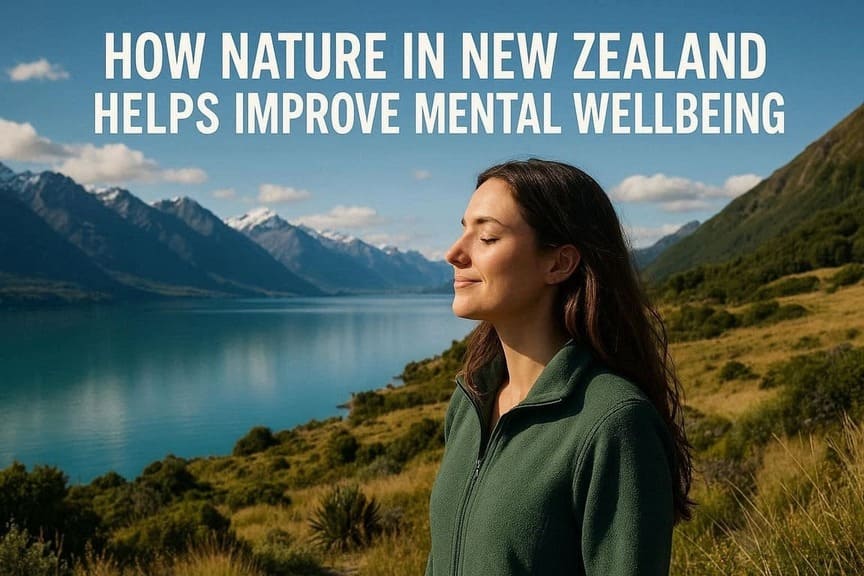
The country has 14 national parks, 44 marine reserves, and a culture that treats going outside like going to therapy. Turns out, that’s not far off.
Search “nature and mental health New Zealand” and you’ll mostly find one of two things: tourism content dressed up as wellness advice (“Visit Milford Sound and feel amazing!”) or dry academic papers that require a research background to decode. Somewhere in between is the actual story — and it’s a genuinely interesting one.
New Zealand sits in a rare position. It has one of the most dramatic, accessible, and diverse natural environments on Earth. It also has a deep cultural relationship with that environment — one that predates European settlement by centuries and continues to shape how Kiwis think about health and belonging. And now the science is catching up to confirm what many here have known intuitively: spending time in nature isn’t a luxury. It’s one of the most effective mental health tools available.
What Most Articles Miss About This Topic
The typical nature-and-mental-health article follows a predictable pattern: “Go outside, it’s good for you. Here are five tips.” The advice isn’t wrong. It’s just shallow.
What these articles tend to skip:
- The mechanism. Why does nature reduce stress at a biological level? What’s actually happening in the brain?
- The dose. How much time in nature produces measurable benefit — and does it matter what kind?
- The cultural layer. In New Zealand specifically, the relationship between people and environment is inseparable from wellbeing in ways that go beyond a weekend hike.
- The equity issue. Not everyone has equal access to nature — and that inequality has real mental health consequences.
Let’s go deeper on all of it.
The Science: What Nature Actually Does to Your Brain
Nature doesn’t just feel calming. It produces measurable, physiological changes.

Time in nature can lower blood pressure and stress hormone levels, reduce nervous system arousal, enhance immune system function, increase self-esteem, reduce anxiety, and improve mood. These aren’t subjective impressions — they’re outcomes measured in controlled studies across multiple countries.
Here’s the mechanism behind it. Stress activates your sympathetic nervous system — the system responsible for the fight-or-flight response, which floods your body with cortisol and adrenaline. Natural environments do the opposite: they activate the parasympathetic nervous system, sometimes called the “rest and digest” mode, which brings heart rate down, lowers blood pressure, and restores cognitive function.
There’s also a specific phenomenon called Directed Attention Fatigue — the mental depletion that comes from constantly filtering the noise of modern urban life. Screens, traffic, notifications, open-plan offices: all of them drain the brain’s attention resources. Nature, by contrast, engages what researchers call “involuntary attention” — a softer, more diffuse kind of noticing that allows the directed attention system to recover. That’s why a walk in a park often produces more mental restoration than a nap on the couch.
Nature walks involving immersive exposure in forest and green spaces have been posited to offer physiological and psychological benefits — and a systematic review of 36 studies with over 3,500 participants found that forest bathing can significantly reduce symptoms of depression and anxiety.
The New Zealand Difference
Every country has parks. New Zealand has something more.
Around 30% of New Zealand’s total land area is protected conservation land — national parks, reserves, and ecological areas. The coastline stretches for over 15,000 kilometres. Native bush covers the hillsides of major cities. Even Auckland, a busy metropolitan centre, sits on a volcanic field surrounded by harbour, beach, and bush reserves within minutes of the CBD.
But the physical geography is only part of it. The other part is the Māori worldview — te ao Māori — which has shaped New Zealand’s relationship with the natural world for centuries.
In te ao Māori, humans are not separate from nature. They are part of it. The concept of kaitiakitanga — guardianship or stewardship — describes the responsibility people have to care for the natural world, not just to benefit from it. The land and sea are not resources to be consumed; they are ancestors to be respected. This is not metaphor. It’s a philosophical framework that continues to influence environmental law, land management, and community values across Aotearoa.
The result is a cultural environment where spending time in nature isn’t seen as a wellness trend or a weekend escape. It’s just part of how life is oriented.
The Māori wellbeing model Te Whare Tapa Whā, developed by Sir Mason Durie in 1984, describes health as a four-walled house — taha tinana (physical), taha hinengaro (mental and emotional), taha wairua (spiritual), and taha whānau (family and social). Crucially, all four walls depend on connection to the land as their foundation. Remove that connection, and the structure weakens.
Nature connectedness is linked to better mental health, particularly lower depression and anxiety. People with strong nature connectedness are also more likely to engage in pro-environmental behaviours — and those behaviours may create a self-reinforcing cycle of benefit.
How Much Nature Is Enough?
This is where competitor content tends to go vague. “Spend more time outside” isn’t useful advice without a sense of scale.
The research gives us something more concrete:
- According to the American Psychological Association, spending at least two hours per week in nature can have measurable benefits for both physical and mental health — and these can be achieved in one session or broken into smaller visits.
- Adults who spent 5–6 hours outdoors on weekends had lower odds of experiencing mild depression compared to those who spent less than 30 minutes outside.
- Among children with significant mental health problems, spending just two hours a week in a natural environment reduced emotional distress — and teachers reported that the children were calmer and more attentive in class afterward, with the biggest changes occurring among those with the most serious difficulties.
The quality of the nature space also matters. High-quality natural spaces — characterised by biodiversity, variety of plants and wildlife, and “serene” landscapes that feel calm and quiet — produce stronger mental health benefits than lower-quality spaces. Cleaner nature areas are linked to lower rates of depression.
New Zealand’s conservation-first culture means that many of its green spaces are genuinely high quality — a significant public health advantage that rarely gets framed that way.
New Zealand’s Specific Natural Environments and Their Mental Health Value
Not all of New Zealand’s landscape is equally accessible, but the range on offer is remarkable:
Native bush and forest trails — The kind of environment studied in most forest-bathing research. Researchers found that forest bathing trips significantly decreased scores for anxiety, depression, anger, confusion and fatigue — and because stress inhibits the immune system, the stress-reduction benefits of forests are further amplified through immune system improvements. New Zealand’s native bush — kauri, kahikatea, rimu, tree ferns — is among the most biodiverse temperate forest in the world.
Coastal and blue spaces — Rivers, beaches, harbours, and lakes. Blue spaces (water environments) show similar mental health benefits to green spaces, with some research suggesting that proximity to water has additional calming effects associated with the sounds and visual movement of water.
Mountains and open landscapes — The Southern Alps, the volcanic plateau, Fiordland: environments characterised by scale and silence. Research on awe — the psychological state triggered by experiences of vastness — shows that it reliably reduces self-referential thinking (the loop of worry and rumination) and increases feelings of connection to something larger than oneself.
Urban parks and green corridors — For the majority of New Zealanders who live in cities, these are the most important and accessible nature spaces. Even in urban environments, finding even a small natural space can be extremely beneficial — and exploring to find it is worth the effort.
Practical Ways to Build This Into Your Life
Whether you’re in New Zealand or just inspired by its approach, here’s what the evidence actually supports:
- Aim for 120 minutes a week outdoors in natural spaces — split however works for you. Thirty minutes, four times a week works as well as one two-hour session.
- Leave your phone in your pocket (or behind entirely) — the cognitive benefit of nature depends on giving your attention to your surroundings, not a screen.
- Seek water when possible — coastal walks, riverside paths, lakeside trails — blue spaces amplify the restorative effect.
- Go slow deliberately — the Japanese concept of shinrin-yoku (forest bathing) isn’t about exercise. It’s about sensory presence: noticing what you can smell, hear, and see at walking pace.
- Find the high-quality spaces near you — biodiversity, cleanliness, and quiet all increase the benefit. A scrubby urban verge helps, but a well-maintained native bush reserve helps significantly more.
- Make it social — community connection amplifies nature’s benefits. A group walk combines two of the most evidence-backed mental health interventions simultaneously.
The Bigger Point
New Zealand hasn’t accidentally become a country with a strong nature-wellbeing connection. It’s a product of geography, of indigenous philosophy, of cultural values that place the land at the centre of identity and health.
Humans evolved in the great outdoors, and the brain benefits from returning to nature — whatever you call it: forest bathing, ecotherapy, mindfulness in nature, green time or the wilderness cure.
The Māori concept of mauri — the life force present in all living things — describes something that modern neuroscience is now mapping in detail: that our wellbeing is not separate from the living world around us. It is dependent on it.
You don’t have to live in New Zealand to apply this insight. You just have to step outside and actually pay attention to what’s there.
Start with two hours a week. Your brain — and everything connected to it — will notice.