
Type “wellness habits” into Google and brace yourself. You’ll get hit with a wall of nearly identical articles — all promising to “transform your life” with a numbered list, a stock photo of someone doing yoga at sunrise, and roughly the same advice recycled since 2015: drink water, sleep eight hours, meditate, exercise more. Thanks. Groundbreaking.
These articles aren’t wrong exactly. They’re just incomplete. They hand you a list and leave you standing there wondering why, three weeks later, you’ve changed nothing.
The problem isn’t the habits themselves. It’s that most wellness content treats you like you have infinite willpower, a free morning, and zero obligations. Real wellness doesn’t work like that. Real wellness is something you build quietly, in the margins of actual life — and that’s what this article is about.
Let’s cut through the noise.
What Most Wellness Articles Get Wrong
Here’s the pattern: a listicle promises “25 habits for a healthier you,” then presents them as equally important, equally easy, and equally urgent. Start meditation. Floss. Declutter your home. Drink 64 oz of water. Buy a fitness tracker. Try a probiotic soda.
The result? Readers feel overwhelmed, attempt everything, succeed at nothing, and quietly blame themselves for lacking discipline.
The better approach is to understand which habits have the highest return on investment — the ones where a small, consistent effort produces a disproportionately large improvement in how you feel. Start there. Build from there.
Here’s what that actually looks like.
1. Sleep Is the Foundation — Stop Treating It Like a Luxury
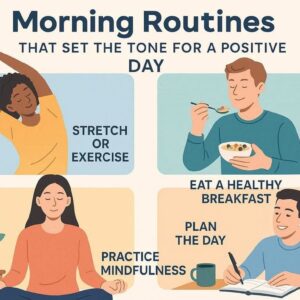
Every credible wellness framework in 2026 puts sleep at the top. Not because it’s trendy, but because the evidence is overwhelming: poor sleep undermines every other habit you try to build. You can’t exercise consistently when you’re depleted. You can’t eat well when your hunger hormones are dysregulated. You can’t manage stress when your nervous system is running on fumes. For better mornings and more energy throughout the day, check out Morning Routines That Set the Tone for a Positive Day.
The target is 7–9 hours of consistent, quality sleep — not just hours in bed, but actual restorative sleep.
A few things that actually help:
- Fix your wake time first, not your bedtime. Waking at the same time daily regulates your body clock far more reliably than trying to fall asleep at a set hour.
- Keep the bedroom cool and dark. Your body temperature needs to drop to initiate sleep. This is biology, not preference.
- No screens in the 30 minutes before bed. Blue light delays melatonin production. This one change alone improves sleep quality for most people within a week.
You don’t need an Oura Ring to know you slept well. You just need to wake up feeling rested. Use technology if it helps, but don’t let gadget-tracking replace the basics.
2. Move Your Body — But Make It Something You’ll Actually Do
The fitness industry has a strange obsession with suffering. The harder the workout, the better. The more you dread it, the more it must be working.
This is not science. This is branding.
The research is fairly clear: consistent moderate movement beats occasional intense exercise in terms of long-term health outcomes. A brisk 30-minute walk every day does more for your cardiovascular health, mood, and longevity than a brutal gym session twice a week followed by three days on the couch.
The principle is simple: find movement you don’t hate. Walking, cycling, swimming, dancing, gardening, hiking — it all counts. The best workout is one you actually show up to.
For those who want more structure, functional fitness is having a strong moment right now — and for good reason. Unlike traditional gym training, it focuses on movements that make daily life easier: carrying, lifting, bending, balancing. Yoga, Pilates, and resistance training all fall into this category.
The one non-negotiable: fight sitting disease. If your job is desk-based, stand up and move for a few minutes every hour. Prolonged sitting degrades your metabolic health in ways that even regular exercise can’t fully offset.
3. Eat Food. Not Too Much. Mostly Plants. (Still the Best Advice)
Nutrition advice online is a swamp. Carnivore vs. vegan. Fasting vs. frequent meals. Clean eating vs. intuitive eating. Every influencer has a framework to sell you, a supplement to recommend, and a before-and-after photo to prove it.
Behind all that noise, the foundational consensus hasn’t really changed:
- Eat more whole foods — vegetables, fruit, legumes, nuts, whole grains, lean protein
- Eat fewer ultra-processed foods — the ones engineered to override your satiety signals
- Cook more of your own meals — it gives you control over what you’re actually eating
- Eat slowly and without a screen — your gut signals take 20 minutes to reach your brain; rush the meal and you overshoot every time
The goal isn’t a perfect diet. It’s a default diet that mostly serves your health, with room for the things you love. Rigidity breeds resentment. Flexibility breeds sustainability.
One practical shift worth making: shop the perimeter of the grocery store. That’s where the fresh produce, fish, meat, and dairy live. The inner aisles are where most of the ultra-processed temptations cluster.
4. Manage Your Stress — Or It Will Manage You
Here’s the thing nobody says plainly enough: chronic stress is quietly one of the most destructive forces in modern health. It disrupts sleep, drives inflammation, degrades gut health, and contributes to nearly every major chronic disease. It also makes you more irritable, less focused, and harder to be around.
Yet most wellness articles treat stress management as a nice-to-have — sandwiched between “try a new hobby” and “practice dental hygiene.”
It deserves more than that.
Effective stress management comes in two forms:
Active tools (things you do to reduce stress):
- Mindfulness meditation — even 5 minutes of focused breathing lowers cortisol measurably
- Physical movement — one of the most reliable mood regulators available
- Time in nature — consistent evidence shows green spaces reduce stress hormones
- Journaling — writing down what’s bothering you externalises it, reducing its grip
Structural changes (addressing the sources of stress):
- Protecting your boundaries around work hours
- Saying no to commitments you genuinely don’t have capacity for
- Building regular rest into your week — not earned rest, scheduled rest
The second category is harder but more powerful. You can meditate every morning and still be burning out if the root causes of your stress remain untouched.
5. Protect Your Social Life Like It’s a Health Metric — Because It Is
This is the habit that gets the least attention and may matter the most.
Research consistently shows that strong social connection is one of the most powerful predictors of longevity and happiness — more impactful, in some studies, than diet or exercise. Loneliness, on the other hand, has health consequences comparable to smoking 15 cigarettes a day.
This doesn’t mean you need a packed social calendar. Quality matters far more than quantity. A few genuine connections, regularly maintained, are worth more than dozens of surface-level ones.
Practical ways to protect your social health:
- Prioritise in-person time with people you actually like
- Say yes to the small gatherings, not just the big events
- Reach out first — don’t wait for others to initiate
- Be present when you’re with people (phones away, attention on)
Social wellbeing isn’t a soft topic. It’s hard science, and it belongs at the centre of any serious wellness conversation.
6. Do a Digital Audit
This one won’t appear on most legacy wellness lists because it’s a genuinely modern problem. The average person now spends over 7 hours a day looking at screens. Much of that time isn’t neutral — it’s anxiety-inducing, comparison-triggering, and sleep-disrupting.
A digital audit doesn’t mean ditching your phone. It means being intentional about how and when you use it:
- Check email and social media at set times, not reflexively throughout the day
- Create a phone-free morning window — even 30 minutes before opening apps
- Remove social media apps from your phone if scrolling feels compulsive (use them on a browser instead — the friction is surprisingly effective)
- No phones at the dinner table. Simple, radical, worth it.
The goal is to use technology on your terms, not the other way around.
The Underlying Truth About Wellness
The most important thing missing from most wellness content is this: habits compound. Sleep improves your exercise. Exercise reduces your stress. Reduced stress improves your sleep. Strong social connections motivate you to take better care of yourself. Cook more and you eat better without trying.
You don’t need to overhaul your life. You need to change a few defaults, give them time to take root, and let the compound effect do the rest.
Start with sleep. Then movement. Then stress. The rest will follow.